Remember When Pro Gaming Happened in Your Friend’s Garage?
There’s something beautifully absurd about Riot Games announcing a $150 million prize pool for Valorant Champions 2026, officially making it the largest purse in esports history. I keep thinking about those early Counter-Strike tournaments where teams would drive cross-country in beat-up vans, splitting gas money and McDonald’s meals, all for a chance at maybe five thousand dollars and bragging rights. Now we’re watching Team Liquid drop thirty-two million on a single player contract for Aspas, and I’m genuinely happy for everyone getting paid, but also quietly mourning something we can never get back.
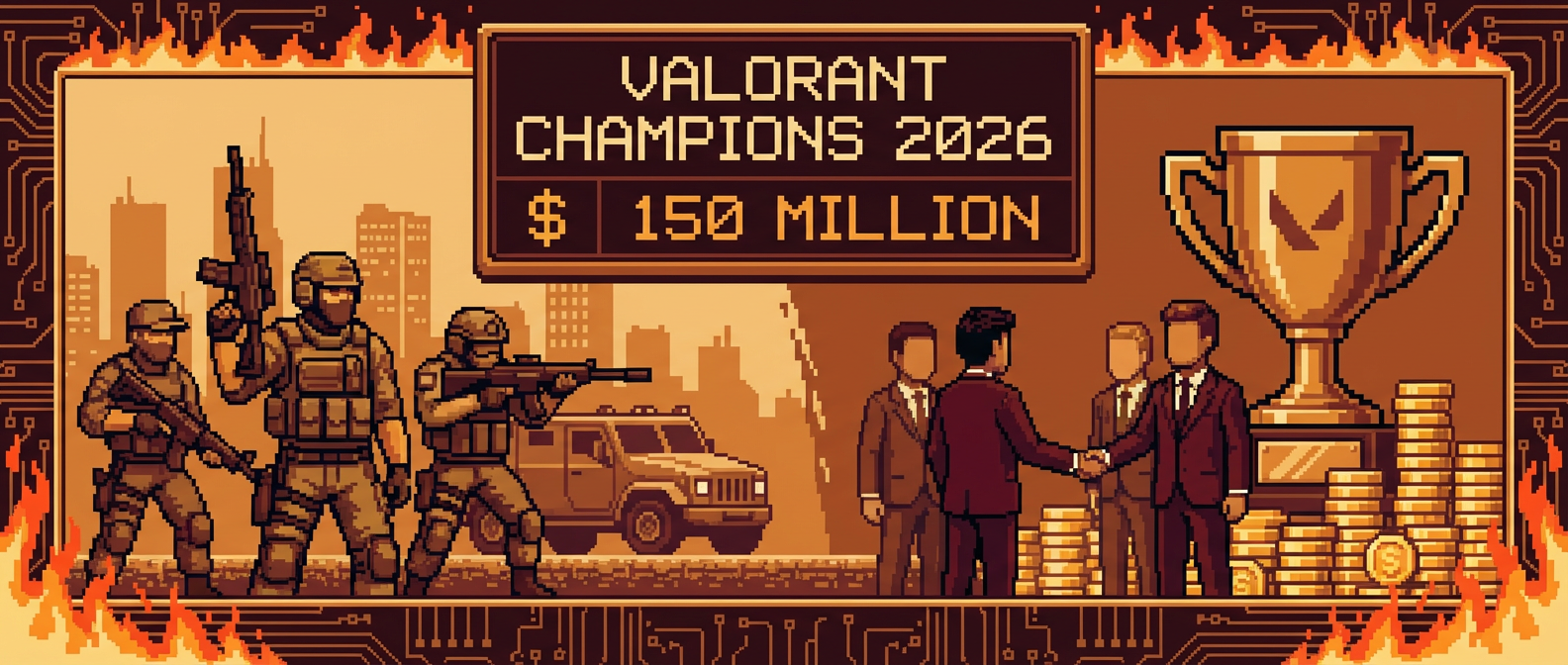
The numbers tell an incredible success story. VCT Masters Tokyo 2026 pulled in 3.2 million concurrent viewers, a 78% jump from the year before. Franchise slots are valued at eighty-five million dollars each according to the Sports Business Journal esports valuations, and Riot’s new AI anti-cheat systems banned nearly a quarter million accounts this season alone. These aren’t just statistics about a game getting bigger. They’re markers of an industry that has completely transformed from scrappy passion project to corporate entertainment juggernaut.

The Professionalization Machine Churns Forward
When I watch today’s Valorant Championships, I see something that would be completely alien to someone who followed early tactical shooters. Every player has a dedicated coach, analyst, mental health specialist, and nutritionist. Teams practice in million-dollar facilities with custom hardware and environmental controls. The Riot Games Valorant esports announcement reads like something from traditional sports, complete with multi-year broadcasting deals and geographic franchise requirements that would make NFL executives nod approvingly.
This professionalization wave didn’t happen overnight, but it feels sudden when you step back. Counter-Strike 1.6 tournaments used to be these beautiful disasters where half the drama happened between rounds when someone’s mouse died or the LAN connection dropped. Players would fix their own technical issues, sometimes mid-round. There was something wonderfully human about watching someone frantically swap out peripherals while their team covered for them. Now that kind of chaos is systematically eliminated by armies of technicians and backup systems.
The talent pipeline has changed too. Aspas didn’t emerge from some internet cafe grind session. Modern Valorant pros are identified early, often as teenagers, and fed through academy systems and development programs that treat esports like any other professional sport. It’s incredibly efficient and definitely produces better players, but it also creates a barrier between the audience and competitors that didn’t exist when your favorite player was literally just some kid who happened to be unnaturally good at clicking heads.
What the Money Changes, and What It Doesn’t
Here’s what I keep coming back to: that $150 million prize pool means genuine opportunities for hundreds of players to make life-changing money doing something they love. When I watch these tournaments, I see kids from backgrounds that never would have allowed them to pursue professional gaming now building careers and supporting families. The financial stability transforms lives in ways that go far beyond the game itself. Team organizations can now offer health insurance, retirement planning, and career development that treat players like human beings rather than disposable assets.
But there’s also something lost in translation when everything becomes this polished. Those early tournaments had this wonderful intimacy where you could genuinely relate to the players. They were using the same equipment you could buy, practicing in conditions that weren’t that different from your own setup. The gap between audience and performer was narrow enough that it felt achievable, like maybe if you just grinded enough hours, you could be up there too.
Modern Valorant esports is undeniably more skillful, more strategic, and more entertaining as a viewing experience. The production values are incredible, the commentary is professional, and the gameplay is the absolute pinnacle of tactical shooter competition. Yet sometimes I watch these perfectly orchestrated events and miss the rough edges that made early esports feel like a community rather than an industry.
The Nostalgia Trap and Moving Forward
I need to be careful here not to fall into the classic “things were better in my day” trap that every generation of gamers eventually succumbs to. The reality is that early esports was often poorly organized, financially unstable, and offered no real future for most participants. Players frequently got exploited, tournaments would disappear with prize money, and the whole scene operated on goodwill and crossed fingers rather than sustainable business practices.
What we’re seeing with Valorant’s massive investment isn’t the death of competitive gaming’s soul. It’s the maturation of something that was always going to grow up eventually. The question isn’t whether this transformation is good or bad, but how we navigate it while preserving what made esports special in the first place. Some of that original energy still exists in smaller scenes, indie fighting game tournaments, and community-run events that operate outside the franchise system.
The best modern esports broadcasts manage to capture both worlds. They have the production quality and professionalism that makes the competition feel important, while still showcasing the personalities and passion that drew us to competitive gaming originally. When Aspas makes an incredible play and you can see the genuine excitement on his face, when teams celebrate victories with the same raw emotion they would have in a basement tournament, that’s when the money and infrastructure works for the human story rather than overshadowing it.
Finding the Magic in the New Landscape
Maybe what I’m really mourning isn’t the loss of scrappy early esports, but the innocence of discovering something that felt like it belonged to us before everyone else figured out it was valuable. Valorant’s $150 million prize pool marks the moment when tactical FPS esports officially became too big to fail, too important to ignore, and too valuable to remain the niche passion project it once was.
But here’s what gives me hope: the core appeal of watching incredible players do impossible things under pressure hasn’t changed. The human drama of competition, the moments of brilliance that make you jump out of your chair, the storylines that develop over seasons and years, those elements transcend budget and production value. The money just makes it possible for more people to participate and for the competition to reach higher levels.
What’s your take on this whole transformation? Have you been following competitive Valorant since the early days, or did the big production values draw you in? I’m always curious how different people experience this evolution, especially those who might be discovering tactical FPS esports for the first time through these massive championship events.