The Late-Night Coffee Conversations That Started It All
Last month, I sat down with three indie developers whose games you might have missed but absolutely shouldn’t have. Sarah Chen, who spent four years crafting the atmospheric puzzle-platformer “Echoes of Tomorrow,” Marcus Thompson behind the surprisingly deep farming sim “Roots & Routes,” and Elena Vasquez, whose pixel-perfect metroidvania “Neon Sanctum” just hit its one-year anniversary. What struck me wasn’t just their passion, but how differently each approached the same fundamental challenge: turning a game idea into something people can actually play.
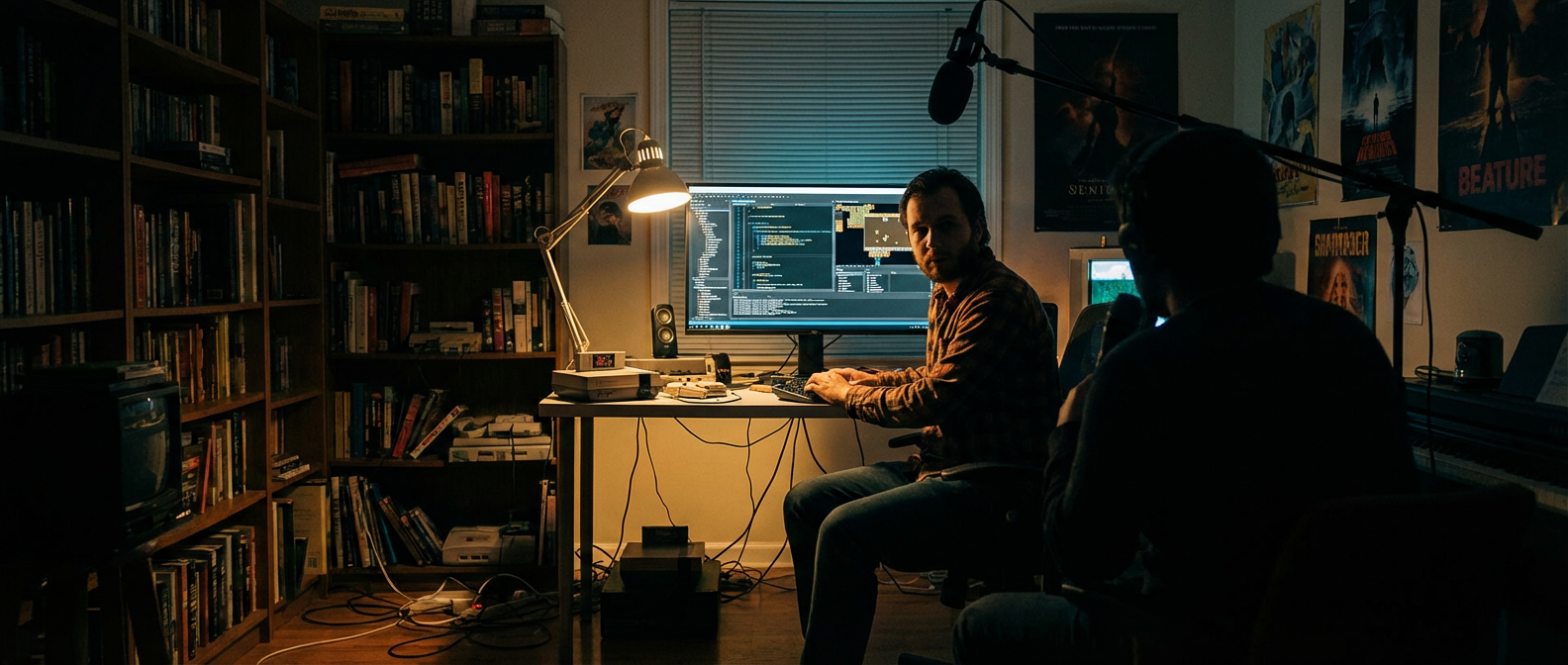
These weren’t the typical “follow your dreams” interviews you see everywhere. Instead, we talked through the actual nuts and bolts of their development process. The tools they swear by. The mistakes that nearly broke them. The moment they knew their game was ready to ship. If you’re sitting on a game idea right now, or you’re knee-deep in your first project wondering if you’re doing it right, these insights might just save you months of headaches.

The Daily Grind: What Building a Game Actually Looks Like
Sarah works a day job as a software engineer and codes her game from 6 AM to 8 AM every morning before work. “People think indie development is all creative bursts and eureka moments,” she told me, “but most days it’s debugging collision detection for the third time this week.” Her setup is remarkably simple: Unity, Visual Studio Code, and a notebook where she tracks daily progress. The notebook isn’t digital. She needs the physical act of writing to process problems.
Marcus took the opposite approach, quitting his marketing job to focus full-time on development. His routine has three distinct phases each day: morning coding, afternoon art and design, evening playtesting. “The hardest part isn’t the technical stuff,” he explains. “It’s maintaining motivation when you’re six months in and your farming simulation feels more like work than the job you quit.” His solution was building a discord community of fellow developers who check in daily. Accountability through friendship, not pressure.
Elena splits her time between freelance art commissions and game development. She discovered that her creative energy peaks at different times for different tasks. Character design happens late at night. Level design works best in the afternoon. Programming requires her sharpest morning focus. “I spent months fighting against my natural rhythms,” she admits. “Once I stopped trying to force creativity and started working with my brain instead of against it, everything clicked.”
The Tools That Actually Matter (And The Ones That Don’t)
Here’s what surprised me most about their tool choices: simplicity wins every time. Sarah uses Unity with just a handful of essential plugins. Her must-haves are DOTween for smooth animations, Cinemachine for camera work, and Odin Inspector for custom editor tools. “I see developers spending weeks evaluating asset store plugins,” she notes. “Meanwhile, their core game loop still isn’t fun. Tools should disappear into the background.”
Marcus built “Roots & Routes” entirely in Godot because he wanted to understand every system in his game. His art pipeline flows through Aseprite for pixel art, GIMP for UI elements, and Audacity for sound editing. Nothing fancy, but he knows each tool inside and out. “When something breaks at 11 PM and you need to ship a patch, you don’t want to be learning your tools.”
Elena surprised me by mentioning her analog tools first. Index cards for level layouts. Graph paper for mapping interconnected areas. Colored pencils for rough mockups. “Digital tools are perfect for iteration and polish,” she explains, “but when I need to think through a complex problem, I need physical space to spread ideas out.” Her digital stack has Aseprite, Tiled for level editing, and a custom Python script that converts Tiled maps into data her game can read.
The consensus was clear: master your core tools completely before adding complexity. Elena put it best: “Every new tool is a trade-off. It might save you time, but it definitely costs you mental bandwidth. Choose carefully.”
The Moment Everything Changed
Every developer has that moment when their game transforms from “interesting experiment” to “something people want to play.” For Sarah, it happened during her first public playtest. “I watched someone play for twenty minutes without saying a word. They were completely absorbed. When they looked up, they asked where they could buy the full version. That’s when I knew I had something.”
Marcus discovered his game’s soul through an unexpected bug. His crop growth system glitched, causing plants to grow in beautiful, impossible patterns. Instead of fixing it immediately, he watched players engage with this broken system for hours, creating art installations in their virtual farms. “That bug taught me my game wasn’t really about farming. It was about creative expression through systems. Everything I built afterward supported that revelation.”
Elena’s breakthrough came from failure. Her initial combat system was complex, with multiple weapon types and combo mechanics. Playtesters were confused and frustrated. “I stripped everything down to a single attack button and focused on making that feel incredible. Sometimes the best feature is the one you remove.” Her simplified combat became the foundation for fluid exploration, which became the heart of her entire game.
The Real Talk About Shipping
None of them felt ready when they finally released their games. Sarah shipped “Echoes of Tomorrow” with a known audio bug that affected 2% of players. “I could have spent another month fixing it, but that month could have been spent on my next game. Perfect is the enemy of shipped.” She fixed the bug in a day-one patch and learned valuable lessons about Steam’s update system.
Marcus struggled with feature creep right until release. His original design document included seasonal events, multiplayer farming, and a full modding system. His shipped game had none of these. “I realized I was designing features to avoid the scary moment of letting people judge my work. The core game was fun. Everything else was procrastination disguised as ambition.”
Elena’s biggest shipping lesson was about marketing timing. She spent months polishing her trailer and presskit, launching into a crowded release week where her game got lost in the noise. “I learned that indie games live or die on word-of-mouth, not perfect timing. Focus on making something people want to tell their friends about.”
What connects all three stories is the recognition that shipped and imperfect beats perfect and never finished. Your game doesn’t need every feature you can imagine. It needs to do one thing incredibly well and give players a reason to care. If you’re building something right now, these developers want you to know that your weird, personal, imperfect vision is exactly what the gaming world needs more of.