The Click That Started It All
Picture this: it’s 2012, and you just unboxed your first mechanical keyboard. Maybe it was a Razer BlackWidow, or perhaps you splurged on a Das Keyboard Professional. You pressed that first key and heard the satisfying click of Cherry MX Blue switches, and suddenly every membrane keyboard you’d ever used felt like typing on soggy toast. That moment probably lives rent-free in your head as the exact second you became a “real” PC gamer.
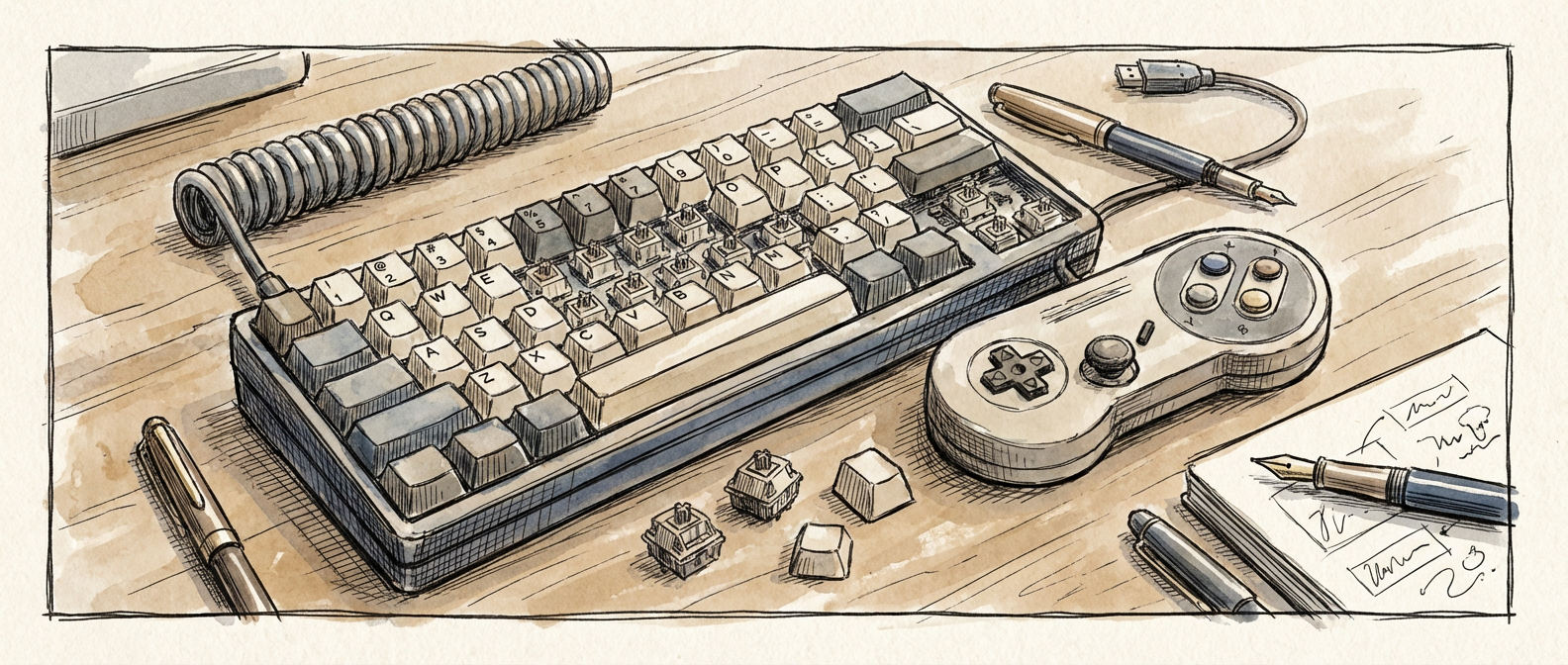
But here’s the thing about nostalgia: it’s a master editor. It cuts out the parts where your roommate threatened to throw that clacky beast out the window during late-night gaming sessions. It glosses over how those tactile bumps felt mushy after six months of heavy use, or how the stabilizers on your spacebar developed that annoying rattle that you convinced yourself added “character.”
I’ve been thinking about this a lot lately while testing modern mechanical keyboards against some vintage models from my collection. The gap between memory and reality is wider than you might expect, and it’s worth looking at why our first mechanical keyboard experiences feel so magical in hindsight.

When Controllers Had Souls (And Also Terrible D-Pads)
The same rose-tinted thing happens with controllers. Ask anyone about their favorite gamepad, and there’s a good chance they’ll mention something from their formative gaming years. The original Xbox controller gets praised for its “substantial feel,” conveniently forgetting that it was nicknamed “The Duke” because it was comically oversized. The Nintendo 64 controller is remembered fondly for enabling revolutionary 3D gameplay, not for its bizarre three-pronged design that left one grip permanently unused.
I recently picked up a pristine DualShock 2 to replay some PS2 classics, expecting that perfect tactile feedback I remembered from countless hours with Shadow of the Colossus. What I found instead was a controller that felt surprisingly small in adult hands, with pressure-sensitive face buttons that never quite worked the way developers intended. The analog sticks had less range than I remembered, and that distinctive rumble feature that seemed so immersive in 2000 now feels like holding a particularly angry cell phone.
This doesn’t diminish what these controllers accomplished back then. The DualShock 2 was genuinely groundbreaking, introducing pressure sensitivity and wireless functionality that modern gamers take for granted. But context matters, and the context of 2000 included controllers that didn’t have dual analog sticks at all.
The Science of Satisfaction
There’s actual psychology behind why our first mechanical keyboard feels like a religious experience. When you’ve been typing on mushy dome switches for years, the distinct tactile feedback of a mechanical switch creates what researchers call a “contrast effect.” Your brain isn’t just processing the new experience. It’s actively comparing it to everything that came before. The greater the contrast, the more intense the satisfaction.
Modern mechanical keyboards are objectively better than their predecessors in almost every measurable way. Switches are more consistent, keycaps are higher quality, and customization options would make 2012 you weep with joy. But they can’t recreate that first-time contrast effect. When every keyboard enthusiast has at least three different switch types and hot-swappable boards, the magic of discovery gets watered down.
The same principle applies to controllers. That first time experiencing force feedback in a racing game felt revolutionary because most of us had never experienced anything like it. Modern haptic feedback in controllers like the DualSense is technically superior in every way, providing nuanced vibrations that can simulate everything from raindrops to the tension of a bow string. But it’s an incremental improvement rather than a complete game-changer.
What We Actually Miss
Stripping away the nostalgia reveals something interesting: what we actually miss isn’t the hardware itself, but the circumstances surrounding it. That first mechanical keyboard represented a moment when you cared enough about your setup to invest in something better. It was often paired with your first serious gaming rig, your first apartment, your first time having disposable income for hobbies.
The controller nostalgia runs even deeper. Those imperfect gamepads are tied to specific games and specific moments in our lives. The N64 controller wasn’t objectively good, but it was the only way to experience Super Mario 64’s revolutionary camera system. The original Xbox controller wasn’t ergonomic, but it was your gateway to Xbox Live and the birth of console online gaming.
I tested a modern recreation of the Model M keyboard recently, complete with the original buckling spring switches. Typing on it felt exactly like the original, down to the distinctive ping of the springs. But something was missing: the context that made the original special. There’s no substitute for experiencing something revolutionary for the first time.
The Honest Retrospective
This doesn’t mean we should dismiss our fond memories or stop celebrating the hardware that shaped our gaming experiences. Instead, we can appreciate these devices for what they actually were: imperfect but pioneering pieces of technology that moved the industry forward. The Cherry MX Blue switches in that first mechanical keyboard weren’t perfect, but they introduced millions of people to the concept that keyboards could be precision instruments rather than cheap peripherals.
The controllers we grew up with had their flaws, but they also pushed boundaries in ways that modern incremental improvements can’t match. Each generation of hardware builds on the previous one, working toward the genuinely excellent peripherals we have today.
Understanding this progression makes me appreciate current hardware more, not less. My daily driver keyboard uses modern switches that are quieter, more consistent, and more durable than anything from the early 2010s. My preferred controller has better ergonomics, longer battery life, and more precise inputs than any gamepad from the PS2 era. But none of them can recreate that first-time magic, and that’s okay.
What hardware from your gaming past do you remember most fondly? I’d love to hear about your first mechanical keyboard or that controller that got you through countless gaming sessions. Drop a comment and let’s compare notes on how our memories stack up against reality.